CSONA, the SUN civil society alliance in Malawi, is proving that advocacy works. By partnering with parliamentary nutrition champions and the SUN Civil Society Network, they’ve fought to secure a bigger national nutrition budget – and to make sure those resources actually reach the districts that need them most. But this isn’t just a story […]
ReadAll Child Nutrition news
Select any topics you are interested in to filter news articles.
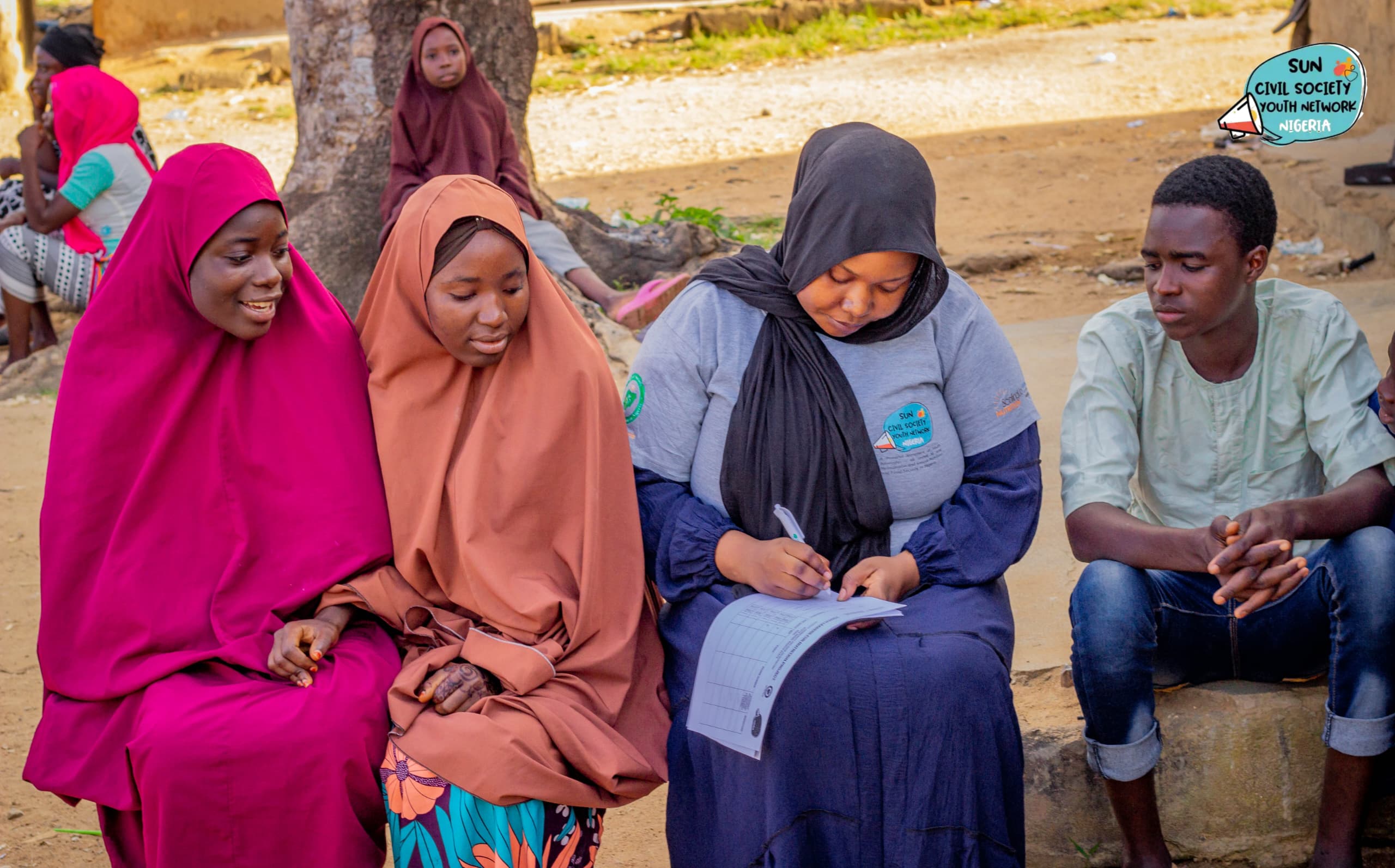
Applications are now open for the SUN CSN Nutrition Dialogues Youth Advocacy Fund!
Overview The SUN Civil Society Network is offering grants of up to €10,000 to Civil Society Alliances (CSAs) for youth-led community dialogues on nutrition. This funding will amplify the voices of marginalised young people and community members, transforming local conversations into concrete policy asks that influence nutrition decision-making from local to global levels. This opportunity builds on the momentum of the Nutrition […]
Read
Civil society voices at the School Meals Coalition Summit
This Thursday, 18 September 2025, governments, partners and civil society will gather in Fortaleza, Brazil, for the second Global Summit of the School Meals Coalition (SMC). More than 40 countries will stand accountable for the commitments they made in Paris two years ago, making it a critical moment to assess progress and push for stronger […]
Read
Where Nutrition Meets Food Systems Transformation: Championing Youth-Led Community Dialogues at UNFSS+4
What happens when you bring together young changemakers from across the globe — all working to fix our broken food systems and end malnutrition in their communities? You get energy. You get vision. And with the right ongoing collaboration, you can get real system-change. That’s exactly what we experienced in May 2025 at the UNFSS+4 […]
Read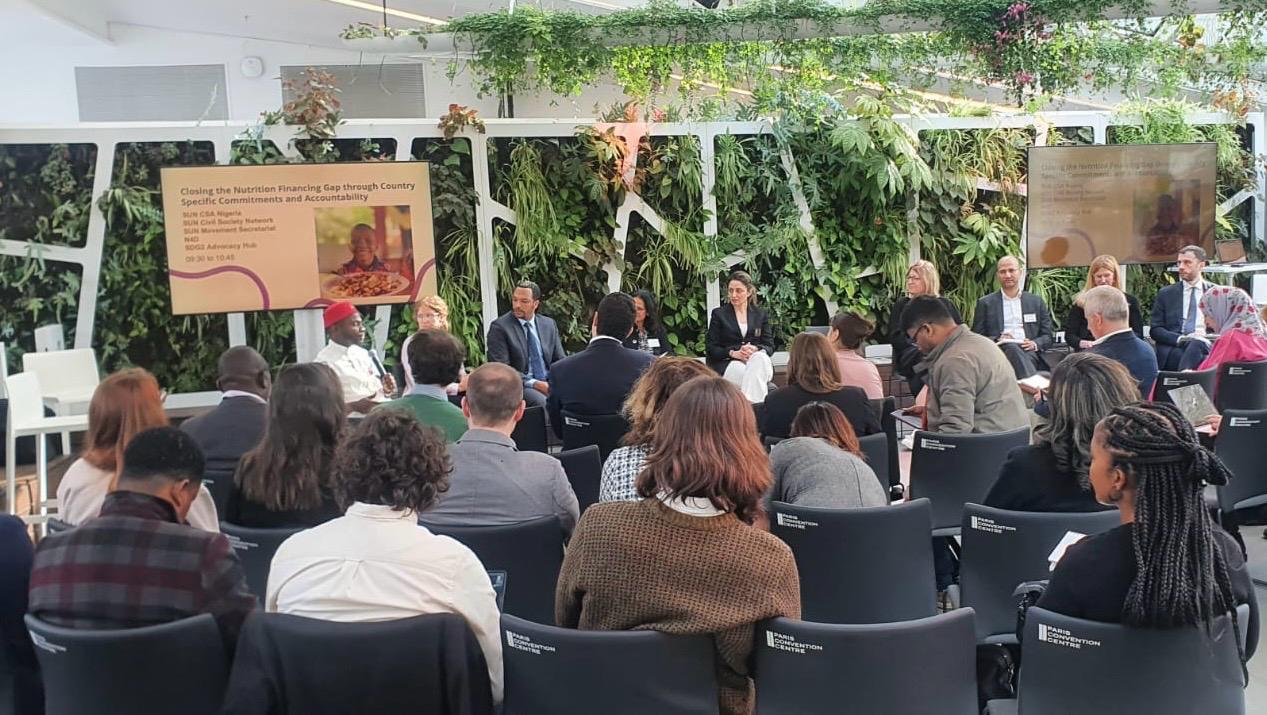
Civil Societies launch a common declaration at Nutrition for Growth Summit (N4G) in Paris 2025
In the margins of the N4G Summit, civil society organisations from across the world gathered for two days in the Civil Society Pavilion to confront pressing challenges in the nutrition landscape and shape a path forward. From these discussions, civil society united behind a set of key recommendations, with over a hundred organisations supporting this […]
Read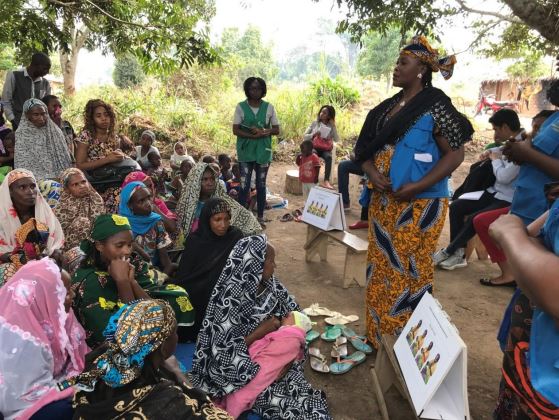
Empowering local voices at the Micronutrient Forum 6th Global Conference: A critical role in shaping the global agenda on nutrition resilience
By Alexandra Newlands, Head of the Scaling Up Nutrition Civil Society Network & Irshad Danish, Senior Advocacy Adviser at Nutrition International, and Chair of the Scaling Up Nutrition Civil Society Network With the contributions of Tanuja Rastogi, Director of Advocacy & Communications, Micronutrient Forum At the forefront of our journey towards a healthier and more […]
Read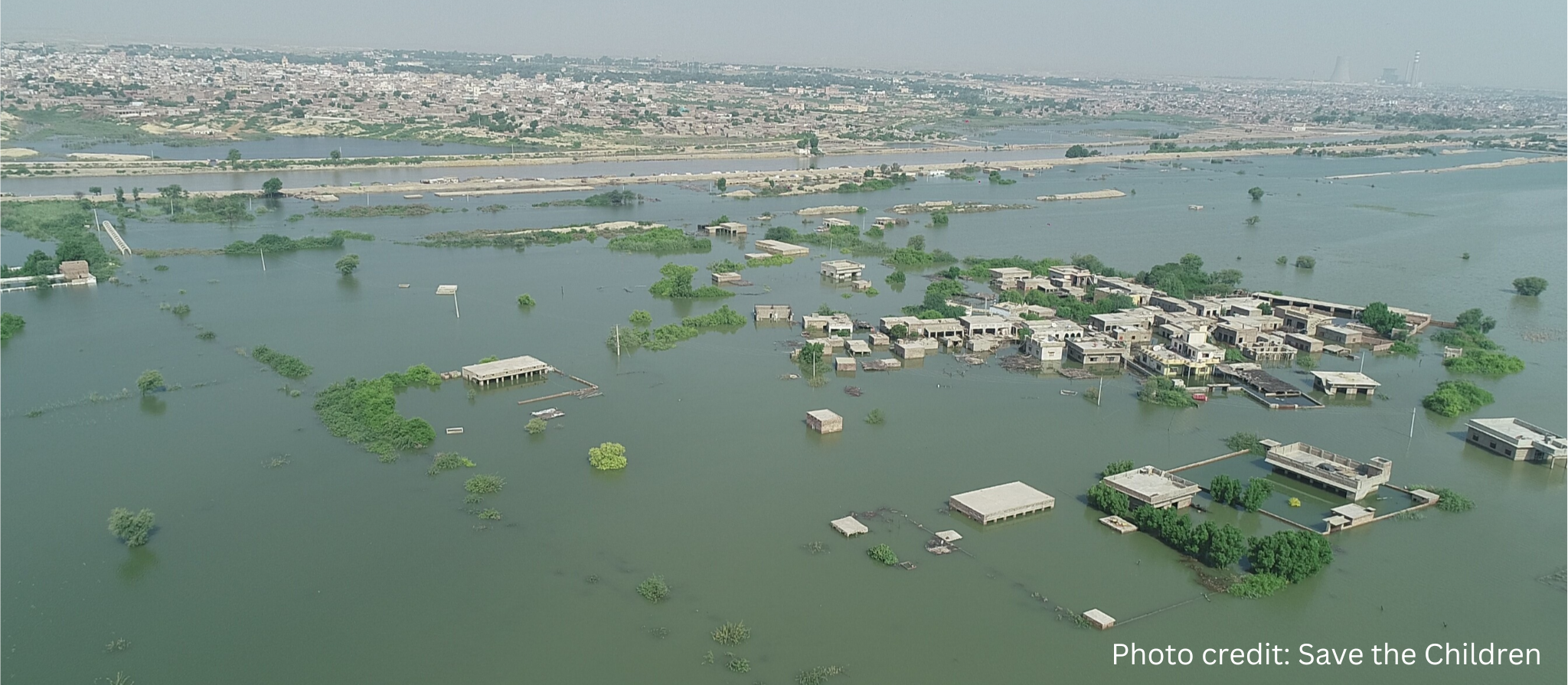
Flooding in Pakistan: Fears for Nutrition and Food Security
Flooding in Pakistan: Fears for Nutrition and Food Security Devastating flooding in Pakistan has swept away crops and stockpiles and left large areas of farmland under water, deteriorating the precarious food and nutrition security in the country. The communities who were already living on the edge now need to cope with this sudden shock of […]
Read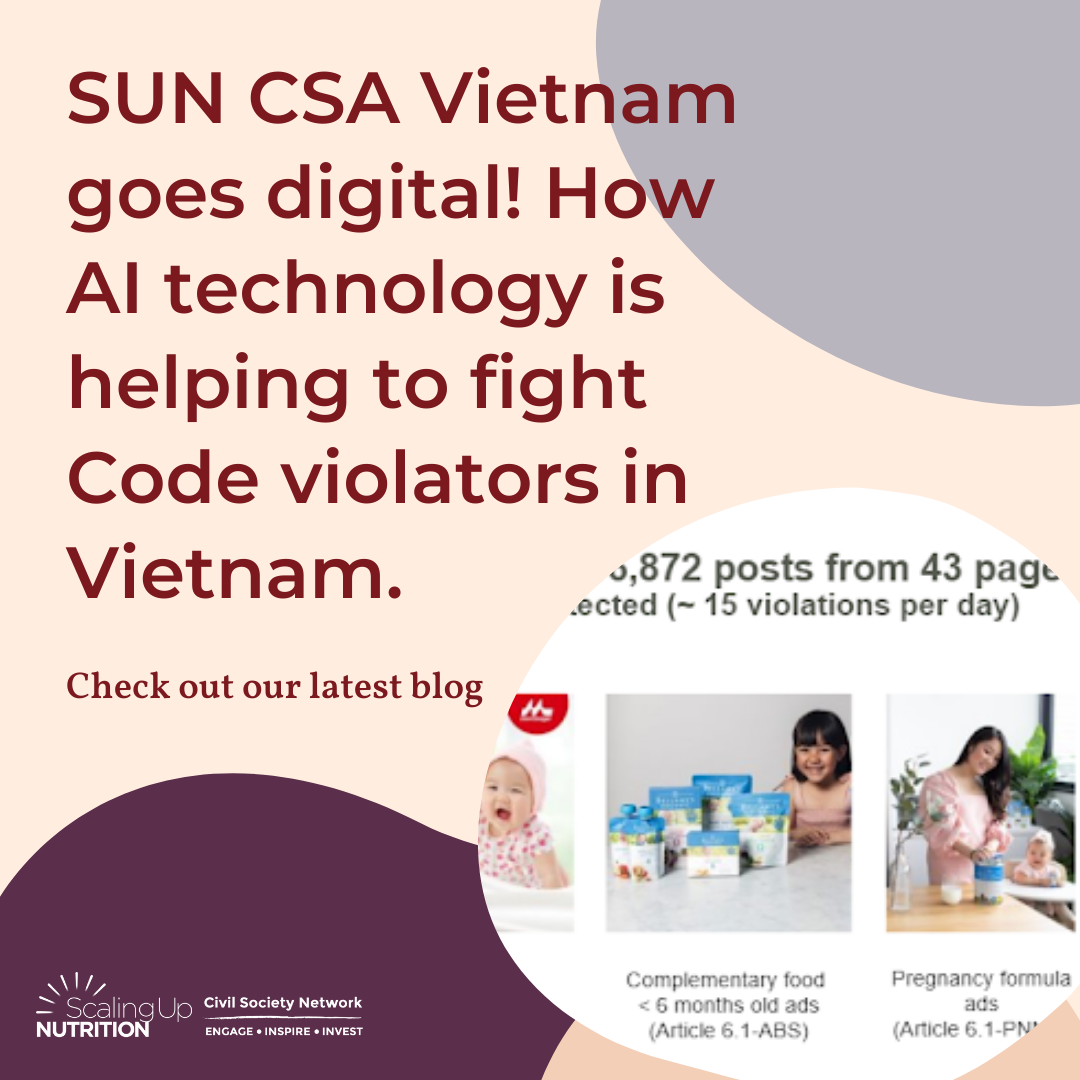
SUN CSA Vietnam goes digital! How AI technology is helping to fight Code violators in Vietnam.
Our Civil Society Alliance in Vietnam, led by Alive & Thrive, and thanks to FHI Solutions’ Innovation Incubator, have teamed up with artificial intelligence (AI) company Hekate. Their aim? To try and end exploitative marketing of commercial milk formula and related products within the scope of the BMS code, on the digital frontline. Hekate, a […]
Read
Life under the Taliban: Obstacles faced in Afghanistan
Part 4: Being a child in Afghanistan Written by Zuhra Dadgar-Shafiq, Programme Director and Co-Founder of Action for Development who provide vital health and education services in Afghanistan to the most marginalized and vulnerable individuals through cost-effective, cascade-model projects that allow for community participation and empowerment. Afghanistan has been struggling with conflict for over 40 years. The situation […]
Read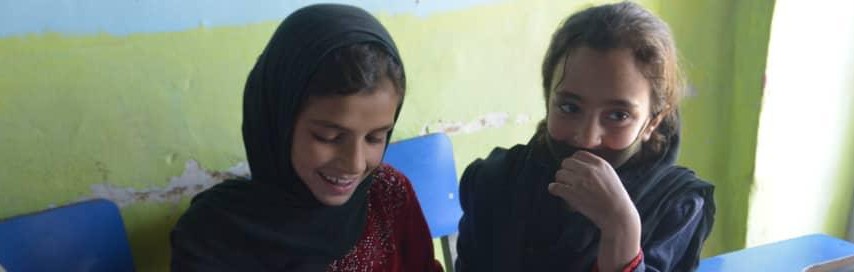
Life under the Taliban: Obstacles faced in Afghanistan
Part 3: Rising food prices Written by Zuhra Dadgar-Shafiq, Programme Director and Co-Founder of Action for Development who provide vital health and education services in Afghanistan to the most marginalized and vulnerable individuals through cost-effective, cascade-model projects that allow for community participation and empowerment. Afghanistan has been struggling with conflict for over 40 years. The […]
ReadSubmit news article
If you’re part of a SUN Civil Society Network and want to share a news article, submit it by filling in the contact form and selecting “Submit a news article in “Reason for contact” so that we can review and publish it.
Part 3: Rising food prices
Written by Zuhra Dadgar-Shafiq, Programme Director and Co-Founder of Action for Development who provide vital health and education services in Afghanistan to the most marginalized and vulnerable individuals through cost-effective, cascade-model projects that allow for community participation and empowerment.
Afghanistan has been struggling with conflict for over 40 years. The situation has recently been exacerbated due to the dire political context and the takeover of the Taliban resulting in social, economic and political instability in the country that has left many people in extremely poor conditions. Currently, it is expected that around 55% of the population (almost 20 million people) will be in food crisis emergency phase 3 and 4 . The WFP has confirmed that one in two people in Afghanistan do not have enough to eat at least once a day.
In addition to the ongoing protracted conflict, the climatic conditions add a burden to the agriculture sector that is suffering from limited investment and low productivity. The food crisis is on the rise caused by the extreme poverty conditions and extreme weather and climatic conditions. Poor pasture conditions and high food prices driven by drought have left over three million livestock at critical risk during winter and has already resulted in increased distress livestock sales. Climate change has caused declining precipitation, putting additional pressure on water resources already strained from population growth. In addition to the drought, more than 29,000 people in 13 provinces were affected by other natural disasters– mostly floods.
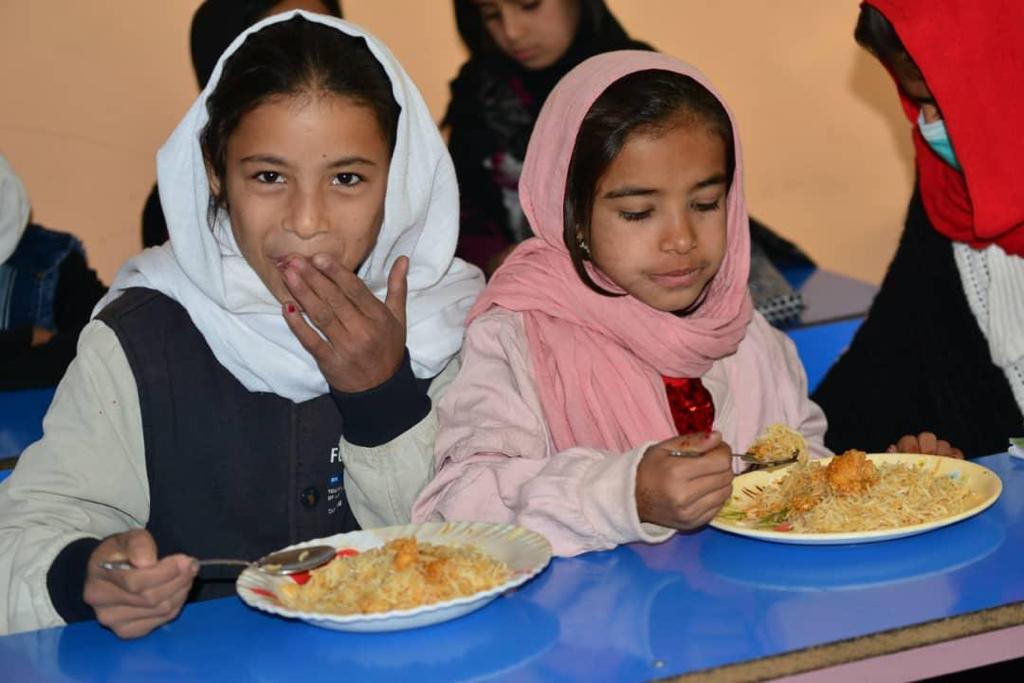
Wheat is the main food for most Afghans, comprising more than 70 percent of their diet. Low-quality rice is a poor, but sometimes necessary, substitute. However, prices for these main food items have more than tripled.
In addition, the average food basket cost had increased by 22 per cent between June and October 2021 alone due to conflict and covid. However, after the takeover of government the costs of immediate food items have increased enormously and are likely to increase even further with the current economic crisis, inflation and cash restrictions Afghanistan is facing. As a result, households will be less likely to purchase food, leading to a further increase in hunger and malnutrition.
The poverty previously was mainly in the rural areas, however, with the loss of jobs, women being unable to get employed, continue their businesses and education (women represent 50% of the population) and as most of them are widows, they are in immense need of support.