In the haor regions of Chhatak and Jagannathpur – remote sub-districts of Sunamganj in northern Bangladesh – severe acute malnutrition (SAM) was quietly devastating young lives. Health facilities existed, but the SAM units at upazila- (county-)level health complexes were not fully functioning. Community awareness was low, and the barriers separating a malnourished child from appropriate treatment were significant.
Compounding the problem was a gap in clinical practice. Within the existing government structure, many health service providers were relying solely on mid-upper arm circumference (MUAC) measurements to screen and manage cases, rather than combining MUAC with weight-for-height Z-score (WHZ), as national protocols recommend. The result was under-identification – children slipping through the system unclassified and untreated.
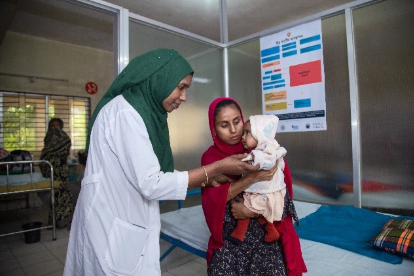
It was into this context that the Transforming Lives Through Nutrition Project, with technical support from Helen Keller International, began working alongside Bangladesh’s Ministry of Health and Family Welfare. Building on existing strengths, Upazila health authorities took the lead in bringing two SAM units into full alignment with national guidelines. Twelve government facility staff were trained in protocol-driven inpatient care, and five joint supervision visits brought twelve national officials directly into the facilities – building ownership so that the work can outlast the project.
Civil society was instrumental to the process. “As a CSO member, we conducted regular visits to upazila health complexes and held advocacy meetings with health authorities to reinforce the importance of continuing SAM management services according to national protocols,” the project team noted. They engaged service providers to improve adherence to proper identification and management guidelines. At the community level, they reached caregivers were reached with clear messages about the importance of seeking facility-based treatment early. The team also participated actively in Upazila Nutrition Coordination Committee meetings to keep services joined up.
The results were significant. Seventy-one Community Nutrition Volunteers (CNVs) screened 52,921 children using MUAC tapes, identifying 250 SAM cases. A further 196 government frontline health workers – Community Health Care Providers, Health Assistants and Family Welfare Assistants – were trained on SAM identification and referral protocols, building a detection capacity designed to outlast the project itself. In total, 103 children received lifesaving inpatient care.
The human meaning of those numbers is perhaps best captured by the people closest to the work. “We bridge villages and hospitals – our referrals ensure no child is left behind,” said CNV Rumana Sharmin. For Dr Nusrat Arefin, Upazila Health and Family Planning Officer in Chhatak, the system’s strength lay in its chain of connected roles: “CNVs detect cases, government workers refer them, and SAM units heal them – it’s one chain.” And for Halima Begum, a mother in Chhatak Upazila, the impact was simply her son’s life: “The CNV found my son wasting away. The government SAM unit saved him with expert care.”
The lesson from Sunamganj is a practical one: advocacy with government health facilities, combined with targeted technical support, can strengthen existing systems rather than replace them – and in doing so, ensure that nutrition services reach the communities that need them most.
