
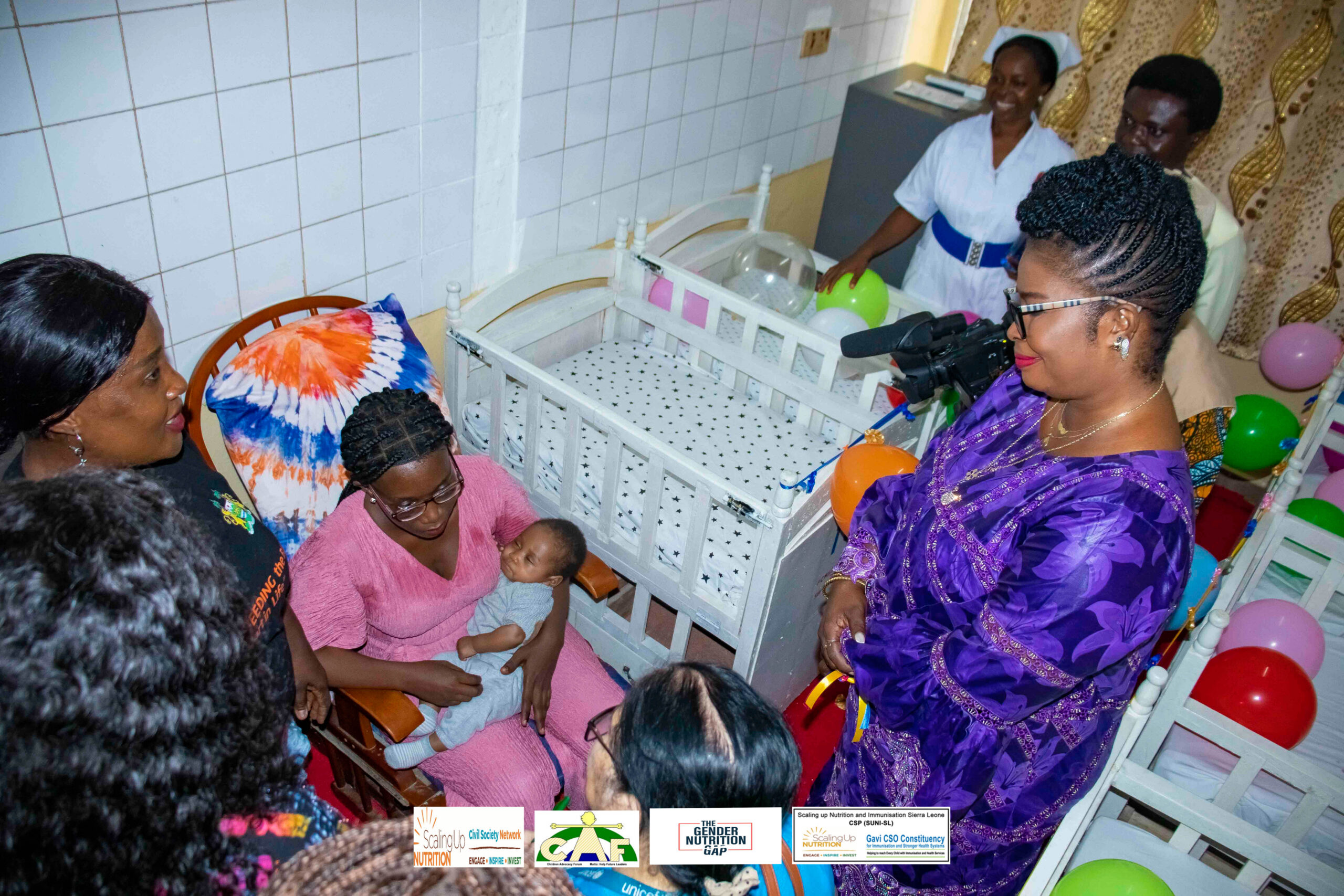
The newly opened lactation room at Princess Christian Maternity Hospital, Freetown
When Mohamed Samura first read through the objectives of the SUN Civil Society Network (SUN CSN)/FHI360 Closing the Gender Nutrition Gap learning exchange programme in 2023, something clicked. «I was truly inspired as they are all geared towards optimising and safeguarding women and girls’ nutrition,» he recalls. A Steering Committee member of the Scaling Up Nutrition Civil Society Platform (SUNI CSP) and Programme Manager at the Children Advocacy Forum Sierra Leone (CAF-SL), Mohamed had long been committed to closing the gender nutrition gap in his country. The learning exchange – a visit to Viet Nam as part of a global cohort of civil society alliances – would give that commitment new direction.
What he saw in Viet Nam were working models: practical examples of how breastfeeding could be supported across very different settings, from formal workplaces to busy public markets. He came home with the outline of an action plan, developed during the visit and drawing on the vast experience in the room. That plan had three interlocking priorities: data-driven accountability on women and girls’ nutrition, stronger national gender nutrition policy, and – the focus that would consume much of his energy over the next two years – maternity protection, specifically expanded paid maternity leave and the establishment of lactation facilities in workplaces in the formal and informal sectors.
Sierra Leone has no national workplace lactation policy. For Mohamed, that absence is both a problem and an opportunity to drive meaningful change. He set about doing exactly that, starting with the resources available to him at SUNI CSP – which, initially, were almost none. The first steps of the action plan – taking part in national breastfeeding campaigns and advocating for women’s and girls’ data to be included in national surveys – had to be taken with no additional financial support.
Having demonstrated such strong commitment to the objective, however, SUNI CSP secured a small grant from SUN CSN to implement activities from Mohamed’s action plan. «The small grant was extremely helpful, and it serves as a springboard for me to advance the vision of this project,» he says.
With funding in place, Mohamed turned to the harder work of building consensus. CAF-SL held extensive consultations with actors from government ministries, departments and agencies, the private sector, and UN agencies – a process he describes as giving him “the unique opportunity to shape the project interventions and build consensus with stakeholders to undertake these interventions”. For women in the informal economy, he focused on local marketplaces, where thousands of women work daily. For formal sector workers, he began engaging government agencies and private-sector partners on establishing lactation facilities at their premises.
Women staff at Princess Christian Maternity Hospital, Freetown
That second strand of work has produced the project’s most visible landmark to date. Through persistent advocacy, local council stakeholders committed to opening a lactation room in Princess Christian Maternity Hospital in Freetown in August 2025.
Mohamed advocating for breastfeeding support during World Breastfeeding Week 2024
The experience has changed Mohamed professionally as well as practically. He points to two personal impacts he hadn’t fully anticipated. The first is a sharpened set of advocacy skills: «I learned new advocacy skills which are geared towards influencing duty bearers for result oriented actions, as well as taking advantage of on-the-spot advocacy opportunities.» The second is access. «This project has contributed greatly in providing me with access to engage with additional high-profiled individuals. I’ve got affiliation with more government [ministries, departments and agencies] and this has increased my participation in most of the high-level engagements organised by these government institutions.»
None of this is an endpoint. Mohamed’s ambition is to see lactation facilities in every local market across the district – and eventually to see them enshrined in national policy. CAF-SL continues to work with civil society organisations, government ministries and other stakeholders to update policy frameworks, and to push for the sustained inclusion of women and girls’ nutrition data in national planning. The learning visit to Viet Nam set something in motion – and the journey continues
